ad

Dutch cabinet urges EU to set minimum age for addictive social media

Dutch cabinet urges EU to set minimum age for addictive social media

The Dutch government, alongside Spain, is urging the European Union to implement a unified minimum age for social media usage to protect children from addictive algorithms and harmful content. They advocate for a consistent age limit, ideally 15 years old, enforced through standardized European age-verification technology to prevent regulatory fragmentation.

The Dutch government is actively lobbying the European Commission to establish a uniform European minimum age for accessing social media platforms. Working in collaboration with Spain, the Netherlands aims to curb the influence of addictive algorithms and harmful content by advocating for a mandatory age limit, ideally set at 15 years old. This proposal seeks to create a standardized regulatory framework across the European Union to avoid the confusion caused by inconsistent national policies and varying restrictions for parents, companies, and regulators.

To enforce these measures, the cabinet supports the implementation of robust age verification tools, potentially through a dedicated European digital identification application. This system would be designed to protect user privacy while ensuring compliance with the new age restrictions. While the exact minimum age remains subject to ongoing debate—with some European factions suggesting 16—the Dutch administration is pushing for a cohesive approach that includes the development of safer digital services specifically tailored for children.

Based on reporting by ad. Translated and condensed by LocalHeadlines.

Related articles

Seizure of 'Antifa server' at US request leads to questions and concerns

Seizure of 'Antifa server' at US request leads to questions and concerns

Dutch authorities have seized a server belonging to the Italian hosting provider Autistici/Inventati at the request of the United States. The U.S. government classifies the company as a terrorist entity, sparking concerns among Dutch digital rights groups and industry associations regarding the precedent for such cross-border legal actions.

EU selects 46 raw materials projects to reduce dependence on China

EU selects 46 raw materials projects to reduce dependence on China

The European Commission has launched 46 projects across sixteen countries to reduce reliance on China for vital raw materials like lithium and copper. These initiatives, supported by prioritized permits and funding assistance, aim to significantly boost domestic processing and recycling capacity by 2030.

Public Prosecution Service was poorly protected against cyberattacks for years

Public Prosecution Service was poorly protected against cyberattacks for years

An investigation has concluded that the Dutch Public Prosecution Service failed to adequately protect its ICT systems for years, leaving them vulnerable to cyberattacks. A security flaw in Citrix software allowed hackers to infiltrate the network last July, resulting in the delay of thousands of court cases and highlighting long-standing neglected warnings about outdated technology.

VNO-NCW chief warns unions and cabinet: 'We are heading down the Belgian path this way'

VNO-NCW chief warns unions and cabinet: 'We are heading down the Belgian path this way'

VNO-NCW chairman Coen van Oostrom has warned the Dutch government and labor unions that the current economic model is unsustainable and risks leading the country toward a decline similar to Belgium. He calls for urgent structural reforms, including a more efficient social security system and proactive measures to retrain workers for the future of artificial intelligence.

Cabinet plans to require homeowners to install hybrid heat pumps starting in 2029

Cabinet plans to require homeowners to install hybrid heat pumps starting in 2029

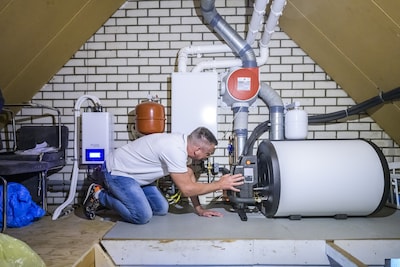
Beginning in 2029, homeowners in the Netherlands must install hybrid heat pumps instead of gas-fired boilers when replacing their heating systems. The government plans to exempt apartments and monuments, while a decision on future subsidies for these costly installations is expected by 2027.