ad

Farmer leader explains burning hay bales during Speech from the Throne: 'We are being smoked out'
Farmer leader explains burning hay bales during Speech from the Throne: 'We are being smoked out'

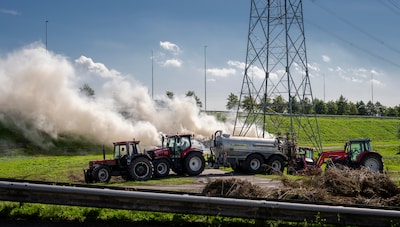
Dutch farmers burned hay bales along highways during the Speech from the Throne to protest government nitrogen policies that threaten their livelihoods. Separately, authorities are investigating large-scale sabotage of the national rail network, though it remains unclear if these incidents are linked to agricultural protest groups.

On the day of the Speech from the Throne, protests erupted across the Netherlands as farmers set fire to hay bales along various highways. Sieta van Keimpema, a representative for the Dutch Dairymen Board, stated that these actions were intended to express the desperation felt by farming families facing potential closure due to the government's strict nitrogen reduction policies. While these protests were expected, the nation is also grappling with the aftermath of massive rail sabotage where over thirty objects were placed on train tracks, causing significant disruption to rail travel.

While authorities investigate the rail incidents, experts and industry representatives express skepticism that established farmer organizations are behind the dangerous rail interference, noting it could severely damage public support for their cause. Instead, observers suggest that such actions may be the work of radical splinter groups or individuals acting independently. Meanwhile, King Willem-Alexander acknowledged the deep uncertainty and pain within the agricultural sector during his address, emphasizing the need to resolve the ongoing nitrogen policy impasse.

Based on reporting by ad. Translated and condensed by LocalHeadlines.
Related articles

The Greenhouse | I prefer to jump on the facts rather than the barricade

The Greenhouse | I prefer to jump on the facts rather than the barricade

A climate journalist explores the tension between objective reporting and the pressure to advocate for systemic change to combat the climate crisis. The author concludes that journalists should remain factual rather than activist to effectively reach a wide and diverse audience.

Trade with Russia remains lucrative, but companies face risks

Trade with Russia remains lucrative, but companies face risks

Despite 21 rounds of European Union sanctions against Russia, some businesses continue to profit by using third-party countries to bypass export restrictions. Experts warn that while such trade is lucrative, it carries significant legal risks, including criminal prosecution and prison time for those who intentionally circumvent these measures.

Seizure of 'Antifa server' at US request leads to questions and concerns

Seizure of 'Antifa server' at US request leads to questions and concerns

Dutch authorities have seized a server belonging to the Italian hosting provider Autistici/Inventati at the request of the United States. The U.S. government classifies the company as a terrorist entity, sparking concerns among Dutch digital rights groups and industry associations regarding the precedent for such cross-border legal actions.

Russia welcomed back to IMF, Netherlands walks out during Russian speech

Russia welcomed back to IMF, Netherlands walks out during Russian speech

Dutch Finance Minister Eelco Heinen and several other delegations staged a walkout during an IMF meeting in Bangkok to protest the presence of sanctioned Russian officials. Minister Heinen emphasized that attending the session alongside these representatives would normalize ongoing Russian aggression.

Future of key climate report uncertain after failed negotiations

Future of key climate report uncertain after failed negotiations

Negotiations for the next IPCC climate assessment report have stalled due to disagreements over its release timeline and budget. While many countries want the report ready for the 2028 international climate policy review, others are pushing for delays, creating uncertainty regarding the organization's future operations.