nu

Cabinet sees no reason for a total ban on camera glasses for now

Cabinet sees no reason for a total ban on camera glasses for now

The Dutch government has rejected a national ban on camera glasses, arguing that existing privacy laws and house rules are sufficient to regulate their use. Officials are currently awaiting a European report to determine if further legal restrictions on the devices are necessary.

The Dutch government has decided against implementing a total ban on camera glasses in public spaces, as State Secretary for Justice and Security Claudia van Bruggen stated such a measure would be overly intrusive. Instead, the government emphasized that existing European privacy regulations are sufficient to address concerns regarding the unauthorized recording and distribution of images. The Dutch Data Protection Authority has clarified that sharing footage of identifiable individuals without their explicit consent is a legal violation, regardless of the recording device used.

Authorities are currently awaiting a forthcoming report from the European Data Protection Board, which will evaluate the legal implications and potential restrictions for smart glasses. In the meantime, private entities such as event organizers, schools, and businesses maintain the right to prohibit these devices through their own house rules. This decision follows recent public debates fueled by groups like the Consumentenbond and privacy organizations who have raised alarms over the potential for surveillance and the inadequacy of indicators that notify others when recording is in progress.

Based on reporting by nu. Translated and condensed by LocalHeadlines.

Related articles

Seizure of 'Antifa server' at US request leads to questions and concerns

Seizure of 'Antifa server' at US request leads to questions and concerns

Dutch authorities have seized a server belonging to the Italian hosting provider Autistici/Inventati at the request of the United States. The U.S. government classifies the company as a terrorist entity, sparking concerns among Dutch digital rights groups and industry associations regarding the precedent for such cross-border legal actions.

EU selects 46 raw materials projects to reduce dependence on China

EU selects 46 raw materials projects to reduce dependence on China

The European Commission has launched 46 projects across sixteen countries to reduce reliance on China for vital raw materials like lithium and copper. These initiatives, supported by prioritized permits and funding assistance, aim to significantly boost domestic processing and recycling capacity by 2030.

Public Prosecution Service was poorly protected against cyberattacks for years

Public Prosecution Service was poorly protected against cyberattacks for years

An investigation has concluded that the Dutch Public Prosecution Service failed to adequately protect its ICT systems for years, leaving them vulnerable to cyberattacks. A security flaw in Citrix software allowed hackers to infiltrate the network last July, resulting in the delay of thousands of court cases and highlighting long-standing neglected warnings about outdated technology.

VNO-NCW chief warns unions and cabinet: 'We are heading down the Belgian path this way'

VNO-NCW chief warns unions and cabinet: 'We are heading down the Belgian path this way'

VNO-NCW chairman Coen van Oostrom has warned the Dutch government and labor unions that the current economic model is unsustainable and risks leading the country toward a decline similar to Belgium. He calls for urgent structural reforms, including a more efficient social security system and proactive measures to retrain workers for the future of artificial intelligence.

Cabinet plans to require homeowners to install hybrid heat pumps starting in 2029

Cabinet plans to require homeowners to install hybrid heat pumps starting in 2029

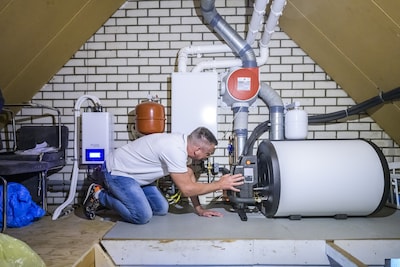
Beginning in 2029, homeowners in the Netherlands must install hybrid heat pumps instead of gas-fired boilers when replacing their heating systems. The government plans to exempt apartments and monuments, while a decision on future subsidies for these costly installations is expected by 2027.